The Practice Problem, Revisited
For coping skills to be accessible during real stress, they must be practiced under conditions that approximate real stress. But real-life stress is unpredictable, uncontrollable, and often overwhelming. You can't repeatedly practice regulation during actual panic attacks, real conflicts, or genuine trauma triggers — the psychological cost would be enormous.
This creates an impossible requirement: skills need stress-state practice, but stress-state practice in real life is harmful. What's needed is something that doesn't currently exist in accessible form: realistic stress without real consequences.
The Goldilocks Zone: Enough Stress, Enough Safety
The ideal training environment for emotional regulation would provide:
- Genuine arousal: Triggers real physiological stress response (increased heart rate, cortisol, muscle tension)
- Complete safety: No actual danger, no lasting consequences, ability to pause or exit anytime
- Repeatability: Practice the same scenario multiple times to build procedural memory
- Progressive difficulty: Start within current capacity, gradually increase challenge
- Real-time feedback: Biometric monitoring showing whether regulation attempts are working
- Personalization: Scenarios adapted to individual triggers, fears, and stress profiles
Why Immersive VR Is Uniquely Suited
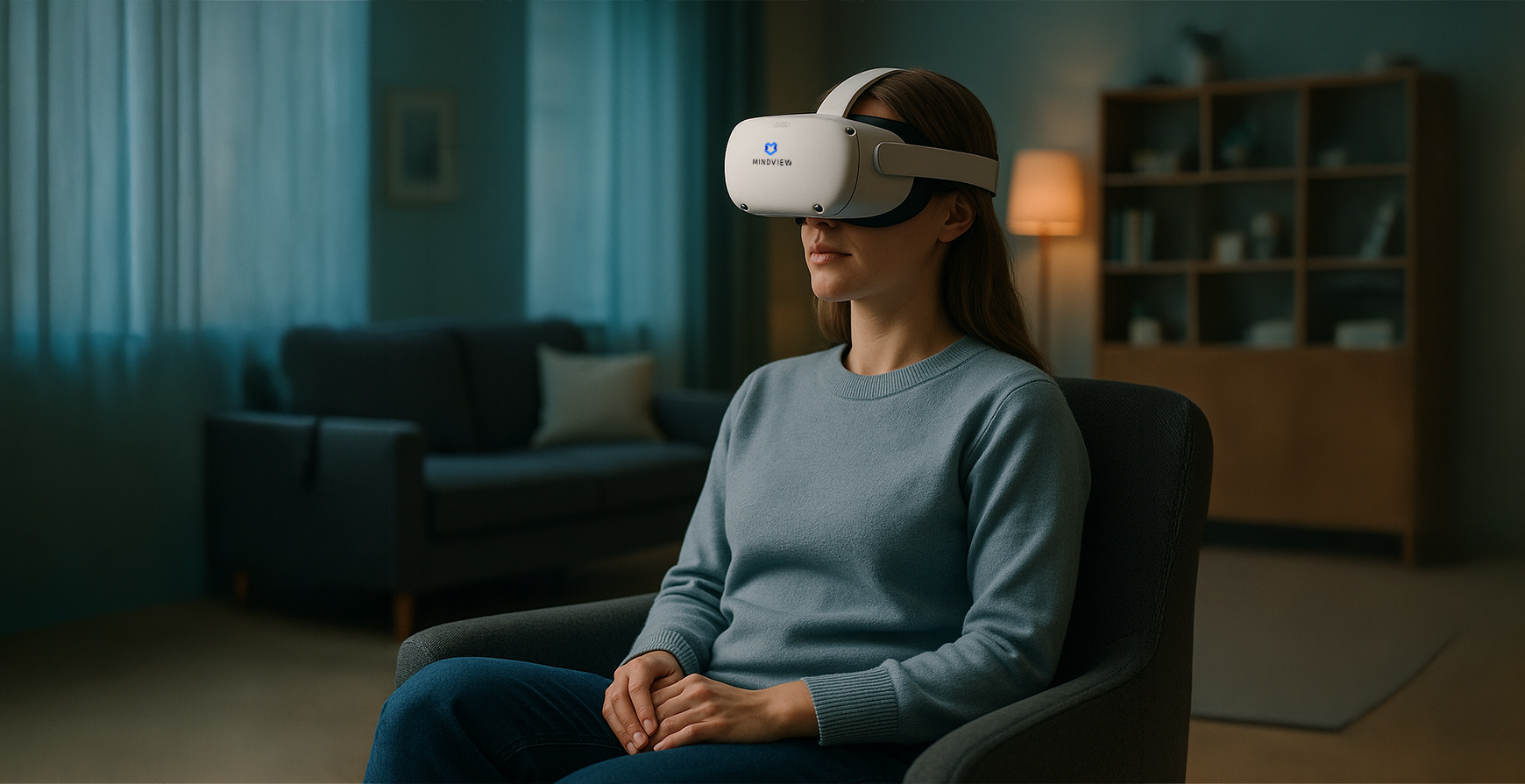
Virtual reality is perhaps the only technology that can deliver this combination. It triggers genuine emotional and physiological responses (presence creates real stress). It's completely safe (you can remove the headset anytime). It allows unlimited repetition (practice the same scenario 50 times). It enables progressive exposure (gradually increase difficulty). It integrates easily with biometric sensors (VR headsets can include heart rate monitors, or connect to wearables). It can personalize scenarios (adjust environments, triggers, and pacing to individual needs).
From Exposure Therapy to Skill Training
Current VR mental health applications focus primarily on exposure therapy: gradually exposing people to feared situations to reduce anxiety. This works for specific phobias and some anxiety disorders. But it's reactive — treating existing problems. The broader opportunity is proactive skill training: teaching people regulation capacities before crisis, in progressively challenging but safe virtual environments.
Imagine: A virtual environment that feels real enough to trigger stress but remains under your control. You practice breathing techniques, grounding, cognitive reframing — not in calm conditions, but while experiencing actual arousal. You see your biometrics shift in real-time as techniques work. You fail safely, adjust, try again. Over weeks, you build embodied capacity that transfers to real life.
The Transfer Question
The critical question: do skills practiced in VR transfer to real-world situations? The research is encouraging. VR exposure therapy for PTSD shows real-world symptom reduction. VR phobia treatment produces real behavior change. VR social skills training improves actual social interactions. The mechanism: when the practice environment approximates the performance environment closely enough (physical, psychological, and functional fidelity), transfer occurs.
This suggests that well-designed VR skill training — matching real-world emotional challenges with appropriate fidelity — should produce transferable regulation capacity. The technology exists. The neuroscience supports it. What's missing is comprehensive implementation.
We've known for decades that emotional regulation is trainable. We've known that practice under stress is essential. We've known that safe, controlled environments enable learning. Virtual reality finally makes it possible to combine all three at scale. The question is whether we'll build it.