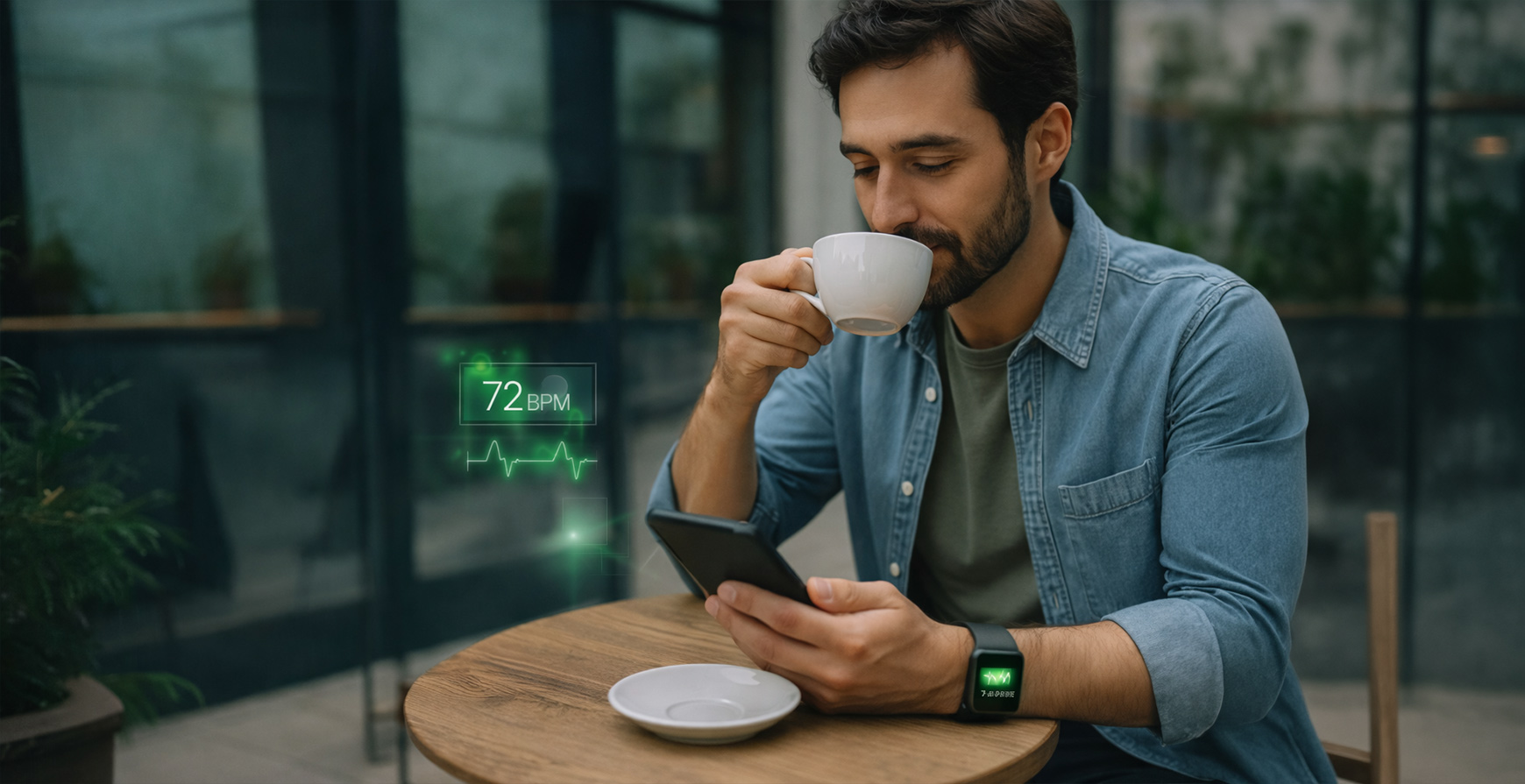
But your smartwatch tells a different story: heart rate has climbed from 70 to 95 beats per minute. Heart rate variability has dropped. Skin conductance is elevated. Your body is in fight-or-flight mode — and your conscious mind hasn't noticed yet.
This gap — between what your body knows and what your conscious awareness registers — is one of the biggest obstacles to effective stress management.
The Problem: Most People Don't Know They're Stressed Until It's Too Late
Stress response activation happens in stages:
- Physiological activation begins. Heart rate increases, breathing quickens, muscles tense. Most people don't consciously notice this yet.
- Subtle behavioral changes. Fidgeting, jaw clenching, speech pattern shifts. Still often below conscious awareness.
- Emotional awareness. 'I'm feeling anxious.' By this point, physiological arousal is already significant.
- Cognitive impairment. Difficulty thinking clearly, making decisions, accessing learned coping strategies.
The problem: most people only become aware of stress at Stage 3 or 4. By then, regulation is exponentially harder than it would have been at Stage 1.
Biometric feedback solves this by making Stage 1 visible.
What Biometric Monitoring Actually Measures
Wearable devices and biometric sensors can track multiple physiological markers of stress:
- Heart Rate Variability (HRV): Variation in time between heartbeats. Higher HRV indicates better nervous system flexibility and stress resilience. HRV decreases under stress.
- Heart Rate: Beats per minute. Increases with sympathetic activation (stress, anxiety, arousal).
- Respiratory Rate: Breaths per minute. Stress typically increases rate and decreases depth.
- Skin Conductance (Galvanic Skin Response): Measures sweat gland activity. Increases with emotional arousal, even when not consciously felt.
- Skin Temperature: Peripheral temperature often drops during stress as blood flow redirects to core organs and large muscles.
Advanced systems can also measure muscle tension (via EMG sensors), cortisol levels (via saliva or sweat), and even brain activity patterns (via EEG).
The Research: Biofeedback for Stress and Anxiety
Biofeedback — using real-time physiological data to guide self-regulation — has been studied extensively since the 1960s.
A 2017 meta-analysis in Frontiers in Public Health examined 23 studies on HRV biofeedback specifically. Results showed significant reductions in anxiety and depression symptoms, with effects maintained at follow-up.
A 2019 review in Applied Psychophysiology and Biofeedback found that biofeedback training:
- Reduced PTSD symptoms in military veterans
- Improved performance anxiety in musicians and athletes
- Decreased panic attack frequency
- Enhanced emotional regulation in children with ADHD
The mechanism is straightforward: when you can see your nervous system state in real time, you can learn to change it.
How Biometric Feedback Creates a Learning Loop
Traditional stress management: you try a technique (breathing, grounding, etc.) and hope it's working. You might feel slightly better, or you might just be distracting yourself. There's no objective way to know.
With biometric feedback:
- 1ou see your baseline: 'My heart rate is 90, my HRV is low.'
- You attempt a regulation technique: Slow breathing, grounding, muscle relaxation.
- You see if it's working: 'Heart rate is dropping to 78... HRV is increasing... it's working.' Or: 'No change... try something different.'
- You adjust based on feedback: Refine the technique, try variations, discover what works for your specific physiology.
This is operant conditioning — you're being rewarded (by visible physiological improvement) for effective regulation. Over time, your nervous system learns which internal adjustments produce desired results.
Early Detection: The Game-Changer
Perhaps the most valuable application of biometric monitoring is catching stress early — before conscious awareness, before cognitive impairment, when intervention is easiest.
Imagine a wearable device that vibrates gently when your HRV drops below a personalized threshold. This isn't telling you that you 'should' feel stressed. It's alerting you that your body is entering stress mode — often before you consciously notice.
At this early stage:
- Regulation techniques work quickly (30 seconds to 2 minutes)
- Prefrontal cortex function is still intact (you can access learned skills)
- Arousal hasn't cascaded into panic or overwhelm
- You prevent escalation rather than trying to recover from it
Early intervention is exponentially more effective than late intervention. Biometric monitoring makes early intervention possible.
The Accessibility Revolution: From Lab to Consumer
Twenty years ago, biometric monitoring required expensive laboratory equipment: EKG machines, respiration belts, skin conductance sensors the size of briefcases.
Today, a $200 smartwatch can measure heart rate, HRV, respiratory rate, skin temperature, and activity levels continuously. Chest strap monitors provide medical-grade accuracy for under $100. Specialized wearables can track additional metrics.
This democratization of biometric data is transformative. What was once available only in research labs or clinical settings is now accessible to anyone with a smartphone.
The Missing Piece: Translating Data Into Skill
Most consumer wearables collect impressive amounts of data. What they don't do is teach you how to use that data to actually regulate your nervous system.
Your fitness tracker shows you that your HRV is low. Great. Now what? Which regulation technique should you try? How do you know if it's working? When should you practice? How do you progress from basic to advanced regulation?
The gap between 'having biometric data' and 'using biometric data to build regulation skills' is enormous.
What's needed is integration: biometric feedback embedded within structured skill-training programs that teach you:
- What your personal stress signals look like
- Which techniques work for your physiology
- How to practice regulation under increasing stress
- When you've developed genuine capacity versus just temporary relief
The Future Is Measured
For decades, emotional regulation training operated in the dark. You learned techniques and hoped they worked. Progress was subjective, based on self-report and clinical impression.
Biometric monitoring brings objectivity. Your nervous system doesn't lie. Heart rate variability either improves or it doesn't. Recovery time after stress either shortens or it doesn't.
This shift — from subjective to objective, from hopeful to measurable — is profound.
The body knows before the brain does. For the first time, we have the technology to listen to what the body is saying — and to learn from it.