
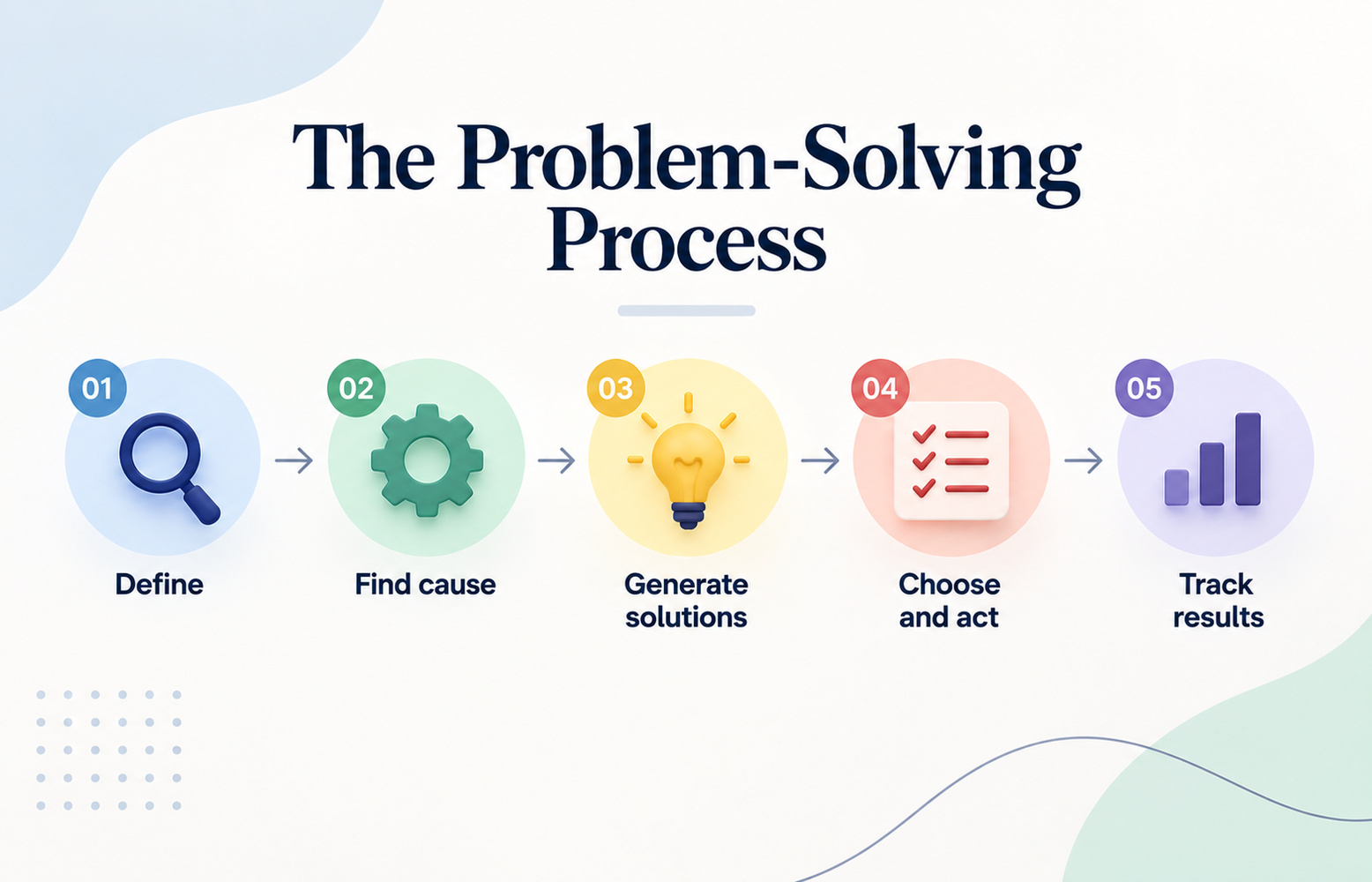
What Is the Problem-Solving Process?
The problem-solving process is the structured sequence of steps people use to move from identifying a problem to acting on a solution and confirming it worked. It isn't owned by one company or field. Versions of it show up in quality management, where a specific methodology like the 8D method walks through it step by step, in workplace and leadership training, and in classrooms teaching decision-making. Root-cause analysis, the category of techniques used to trace a problem back to what's actually causing it, is usually one part of that process rather than another name for the whole thing. What holds all the different versions together is the same basic logic: understand what's actually wrong before trying to fix it, consider more than one way to fix it, then check whether the fix worked.
It helps to name what's happening underneath the steps, too. Problem-solving is often described as a higher-order cognitive skill, meaning it draws on more basic abilities like memory and attention but organizes them toward a specific goal. That's a formal way of saying the same thing the practical version says: solving a real problem takes more than reacting to it.
In practice, it comes down to five moves: define the problem, find the root cause, generate possible solutions, choose and act, then track the result. The rest of this article walks through each one, along with what changes about all five when there's real pressure attached.
Why Problem-Solving Falls Apart Under Pressure
The five steps below look straightforward on paper. They get harder to follow the moment there's a deadline attached, a stakeholder waiting on an answer, or a decision that has to happen now instead of after a careful review. Problem-solving is a healthy way people cope with a demanding situation, and it's also easy to rush or skip once the pressure is on.
A 2025 study in Communications Psychology put 42 university students through a standard stress-induction task, then had them work through a series of decisions that varied in difficulty. Across the whole group, higher stress was linked to lower decision accuracy, and that decline was concentrated on the harder decisions; easy ones held up fine. Among the subset of participants whose bodies showed a measurable stress response, the pattern looked different: accuracy dropped across easy and hard decisions alike, not just the difficult ones. The researchers also flagged, as an exploratory result they say needs more research, that the sharpest drop showed up specifically on decisions where participants used every second of the time they were given, a pattern strongest in that same stress-reactive group.
That distinction matters. The best-supported part of this finding is that stress measurably hurt decision accuracy in this study, more so on harder problems for the group as a whole, and across the board for the people whose stress response was strongest. The added risk tied specifically to running out of time is real but earlier-stage evidence, one study on one sample of university students, not a settled fact on its own.
None of this makes problem-solving under pressure impossible. It means the process needs to hold up when it's rushed, not just work under ideal conditions. Decision-making under pressure is part of ordinary work: the report that's late again, a client escalation that lands at 4:45 on a Friday, an outage that needs a call in the next ten minutes. The five steps don't change in those moments. What changes is how much room there is to do each one carefully, which is what the next section is built around.
A Practical Five-Step Process
Other guides break this into anywhere from four to eight steps. This is a practical five-step version that captures what most of them agree on.
Define the Problem
The first step is naming the problem specifically enough that everyone agrees on what it actually is, not just what it feels like. "The team is disorganized" is a feeling, not a problem statement, and it's too vague to act on. A useful problem statement says what's happening, how often, and since when.
Imagine a team whose weekly status report keeps slipping past its Friday deadline. The vague version of the problem is "we're behind." The specific version is "the report has missed its deadline four of the last six weeks, usually by a day or two." The second version can be solved. The first one just describes a mood.
Getting this step right takes longer than it feels like it should, especially under pressure, when the instinct is to skip straight to fixing something. It's worth the extra few minutes. A precisely defined problem makes every step after this one faster, not slower.
Find the Root Cause
Once the problem is defined, the next step is figuring out what's actually causing it, not just where it shows up. This is where root-cause analysis earns its name: tracing a problem back past its symptoms to the thing actually producing them. One common version of this is the 5 Whys technique, asking "why" repeatedly, usually around five times, until the answers stop describing a symptom and start describing a cause.
Back to that late weekly report: the first answer to "why is it late" might be "the person writing it ran out of time." Asking why again might reveal that they're waiting on numbers from another team, who deliver theirs on Thursday afternoon at the earliest. Asking why once more might show that Thursday delivery is itself the bottleneck for two other reports, not just this one. The real cause isn't a discipline problem on the writer's end. It's a scheduling dependency nobody had mapped out.
This step is easy to skip under pressure, because it's tempting to act on the first plausible explanation instead of the actual one. A fix aimed at the wrong cause tends not to hold.
Generate Possible Solutions
With the real cause identified, the next step is coming up with more than one way to address it before committing to any of them. The first idea that comes to mind isn't always the best one, and it's worth resisting the urge to act on it immediately, especially when time is short.
For the team with the late report, a few real options emerge once the actual cause is clear: renegotiate the Thursday delivery deadline with the upstream team, automate the part of the report that depends on their numbers so it updates on its own, or move the report's own due date to account for the dependency instead of fighting it.
None of these options is obviously correct on its own. That's the point of generating more than one: the choice in the next step should be made deliberately, between real alternatives, rather than defaulted into because it was the first thing anyone suggested.
Choose and Act
Choosing between the options means weighing them against the real constraints of the situation: who's available to own the fix, how much time there is, and what counts as good enough given both. Under pressure, it's more useful to commit to a decision that's good enough than to keep debating toward a theoretically perfect one.
For the late-report team, renegotiating someone else's deadline takes time and isn't fully within their control. Automating the report would remove the Thursday dependency for good, which makes it the most durable of the three options, but it takes longer to build than the team has this week. Moving the report's own due date is the option that's available right now, so that's what gets chosen, with automation logged as a follow-up once there's room for it.
What matters most in this step is committing to one option, assigning it to someone by name, and moving forward instead of staying stuck comparing alternatives.
Track the Result
The last step is easy to skip once the pressure that caused the problem has passed: checking whether the fix actually worked. It's tempting to treat "we made a decision" as the same thing as "the problem is solved," but those aren't the same claim, and only one of them can actually be verified.
For the report that kept slipping, tracking the result means checking a few weeks later whether it's actually landing on time with the new due date in place, not just assuming it is because a decision got made. If it's still late, that's a signal to investigate: maybe the new due date didn't leave enough buffer after the Thursday handoff after all, maybe something about the team's process changed since the decision was made, or maybe the automation fix that got logged as a follow-up needs to happen sooner than planned. Any of those is worth ruling in or out before repeating the same fix and hoping for a different result.
Skip this step and the same root cause often resurfaces later as a seemingly different problem.
Protecting Your Problem-Solving When the Pressure Is On
The five steps above are the mechanics. Staying able to use them when the pressure is highest is a separate skill, and it's one with some real research behind it.
In a 2013 study published in PLoS ONE, researchers had participants rank a list of personal values, then write briefly about why their top-ranked value mattered to them, before putting them through a pressured problem-solving task where an evaluator pushed them to "try harder." Participants who'd written about a value that actually mattered to them performed better on that pressured task than participants who wrote about a value near the bottom of their own list, and the difference was largest for participants who'd reported higher stress in their daily lives over the past month.
The study doesn't say how long that writing exercise took, so what follows is this article's own practical translation of the finding, not something the researchers tested directly: before a high-stakes moment, take a short pause to remind yourself of something that matters to you and why. It's a small, low-effort step, and the research doesn't guarantee it works the same way for everyone. What it does show is that chronic stress doesn't have to translate into worse performance under pressure. How someone frames a pressured moment going in seems to matter.
One more practical habit worth building alongside this: under pressure, name the specific decision that needs to happen next, not the whole problem at once. "We need to fix the reporting process" is overwhelming and vague. "We need to decide who owns the Thursday handoff by end of day" is a decision an actual person can make in the next hour. Breaking a large problem into the one decision immediately in front of someone is one of the more reliable ways to keep moving instead of freezing.
Frequently Asked Questions
What Are the 5 Stages of Problem-Solving?
The five stages covered above are defining the problem, finding the root cause, generating possible solutions, choosing and acting, and tracking the result. See the full breakdown in the section above for how each one works in practice.
What Are the 7 Steps to Problem-Solving?
There's no single agreed-on number. Some guides use four steps, some use five, and others break the same process into as many as eight. A well-known version from the American Society for Quality uses four: define, diagnose, solve, and sustain. The University of Iowa's HR department publishes an eight-step version for its own teams. Both describe the same underlying logic as the five-step version above; they just draw the lines between stages differently.
What Are the 5 C's of Problem-Solving?
There's no single standardized version. Different consultants and companies use "the 5 C's" as a label for their own specific frameworks, and those frameworks don't agree with each other. Author Brené Brown, for instance, has a well-known "5 Cs" model, Context, Color, Connective Tissue, Cost, and Consequence, but she frames it specifically for strategic thinking, decision-making, and delegating, not as a general problem-solving process, and it's a different concept from the incident-analysis versions some companies use internally.
Is Problem-Solving a Skill?
Yes. It's trainable, the same way any structured process gets easier with repetition, not a fixed trait some people have and others don't. The more often someone works through the steps, especially under real conditions, the more automatic they become.
How Can You Improve Your Problem-Solving Skills?
Mainly by using the steps above on real problems instead of only reading about them, since the process gets more automatic with repetition. It also helps to practice under conditions that actually resemble the pressure of a real decision, not just in a calm, low-stakes setting. See the section above on protecting your problem-solving under pressure for a specific, research-backed way to do that.
Practiced Before the Pressure Hits, Not Figured Out in the Moment
None of the five steps above are complicated on their own. What's hard is running through them cleanly when there's no time to think and something real is on the line, which is exactly when most people default to whatever reaction is fastest instead of the step that's actually needed.
MindView trains resilience and composure using the same idea: putting people through realistic VR scenarios built around controlled social and time pressure, giving them a place to practice staying steady and working through decisions before they need to do it for real, the way a fire drill lets people rehearse an emergency before one happens. Book a demo to see what that training looks like.